The Knowledge LedgerThe Knowledge LedgerFollow on WhatsApp

A curated stream of high-signal insights across Technology, Healthcare, Lifesciences, AI, Oncology, Business, Entrepreneurship, Leadership, Philosophy and beyond.

Thoughtful, cross-disciplinary content designed to expand how you think, not just what you know.

No noise. Only substance.

Filtered by #future-of-workClear filter
Sep 2, 2026·x.com

We Already Externalized Muscle. Now Mind.

For most of history, physical work was muscle. Then steam, combustion, and electric motors took it. Human muscle became a rounding error in the global energy budget. Cognitive work is on the same curve, compressed in time.

When the price of a scarce input collapses, supply floods and demand expands. Cheaper engines did not reduce coal use. They multiplied it. Cheaper cognition will not reduce thinking. It will multiply it. Most problems on Earth currently go unthought about because thinking is expensive.

Aug 27, 2026·x.com

When You Become the Infrastructure

Give agents computers, memory, tools, and enough autonomy to keep working after you leave, and a hidden job appears. The human becomes the infrastructure: routing work, restoring context, reconnecting stale sessions, and carrying findings between specialists.

Making each agent smarter does not remove that load. Two agents can both claim the same task and both answer well, producing one failed collaboration. An ordinary request to put a workspace on GitHub can quietly include credentials. The agent that created a project’s canonical repository can later forget that the repository exists. A bot can send 34 true alerts about the same stalled job and destroy the channel as a signal.

Jul 26, 2026·x.com

Escaping India

For a large section of high-performing Indians, the highest form of self-actualization is not building something lasting inside the country. It is escaping it.

Escape takes two primary forms. The first is physical: leaving India through education, visas, and settlement abroad. The second is domestic: withdrawing into gated societies that function as private islands of order inside a disordered public sphere. Both are responses to the same underlying conditions.

Jul 24, 2026·open.substack.com

The AI Job Apocalypse Is a Misread

The dominant narrative says AI will cause mass unemployment. Three years of real data say otherwise.

Over 90% of U.S. firms that adopted AI reported zero change in headcount. Multiple surveys from the Atlanta Fed, Census Bureau, and other sources show the same pattern: almost no net job loss. What is happening instead is task reallocation inside existing roles. Recruiters do less screening and more judgment work. Lawyers review AI output rather than draft from scratch. Finance teams interpret rather than assemble data.

Jul 14, 2026·cs.princeton.edu

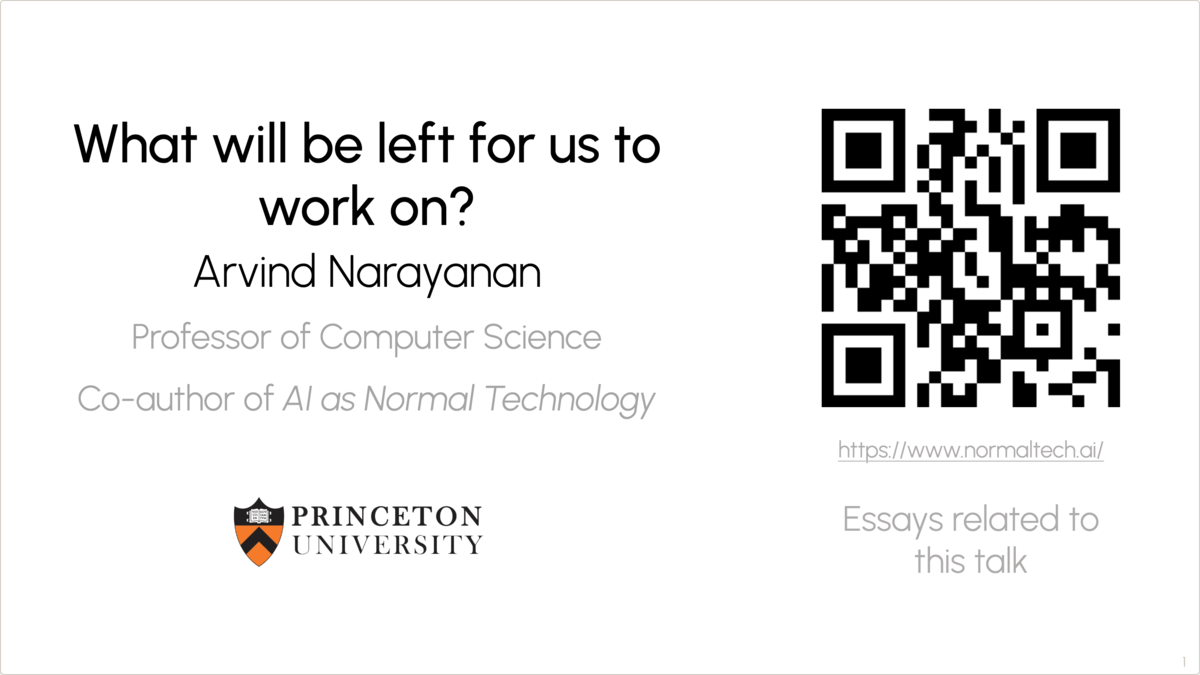
Beyond Replacement: AI as Normal Technology

In his ICML 2026 keynote, Arvind Narayanan examines two competing narratives about AI’s future that have existed since the field’s beginning:

•⁠ ⁠The replacement narrative, which assumes AI will make many human skills obsolete, leading people to prioritize building wealth and power before their expertise becomes irrelevant.

Jul 5, 2026·x.com

When AI Masters Graded Problems, Problem Selection Becomes the Edge

AI models are getting extremely good at anything that can be turned into a clear loss function or well-defined, gradable task — schoolwork, LeetCode, standard engineering problems, and most routine coding.

In this environment, the highest-leverage human skills are shifting to the areas that are hardest to grade or automate within a single training loop:

Jun 16, 2026·x.com

The Sovereign Builder Era

The traditional corporate career — a linear path of loyalty in exchange for stability — is structurally breaking down.

In its place, a growing number of knowledge workers are treating salaried employment as a financing mechanism: using the stable cash flow and resources from a corporate job to fund the construction of their own independent digital assets and ventures.

Jun 15, 2026·x.com

The Learning Loop: Human Capital Meets Token Capital

In an AI-driven economy, the future of the firm depends on building a “cognitive loop” between people and digital systems — one where human judgment and AI capabilities continuously compound.

Satya Nadella introduces the idea of *human capital* (knowledge, judgment, relationships, ingenuity, and pattern recognition) and token capital(the firm’s proprietary AI capabilities and learned systems). Contrary to common fears, he argues that human capital does not become less valuable as AI advances — it becomes more valuable when paired with owned AI systems.