
The Knowledge LedgerThe Knowledge LedgerFollow on WhatsApp

A curated stream of high-signal insights across Technology, Healthcare, Lifesciences, AI, Oncology, Business, Entrepreneurship, Leadership, Philosophy and beyond.

Thoughtful, cross-disciplinary content designed to expand how you think, not just what you know.

No noise. Only substance.

Filtered by #multi-agent-systemsClear filter
Sep 13, 2026Β·x.com

More Agents Inside, Fewer Agents on the Network

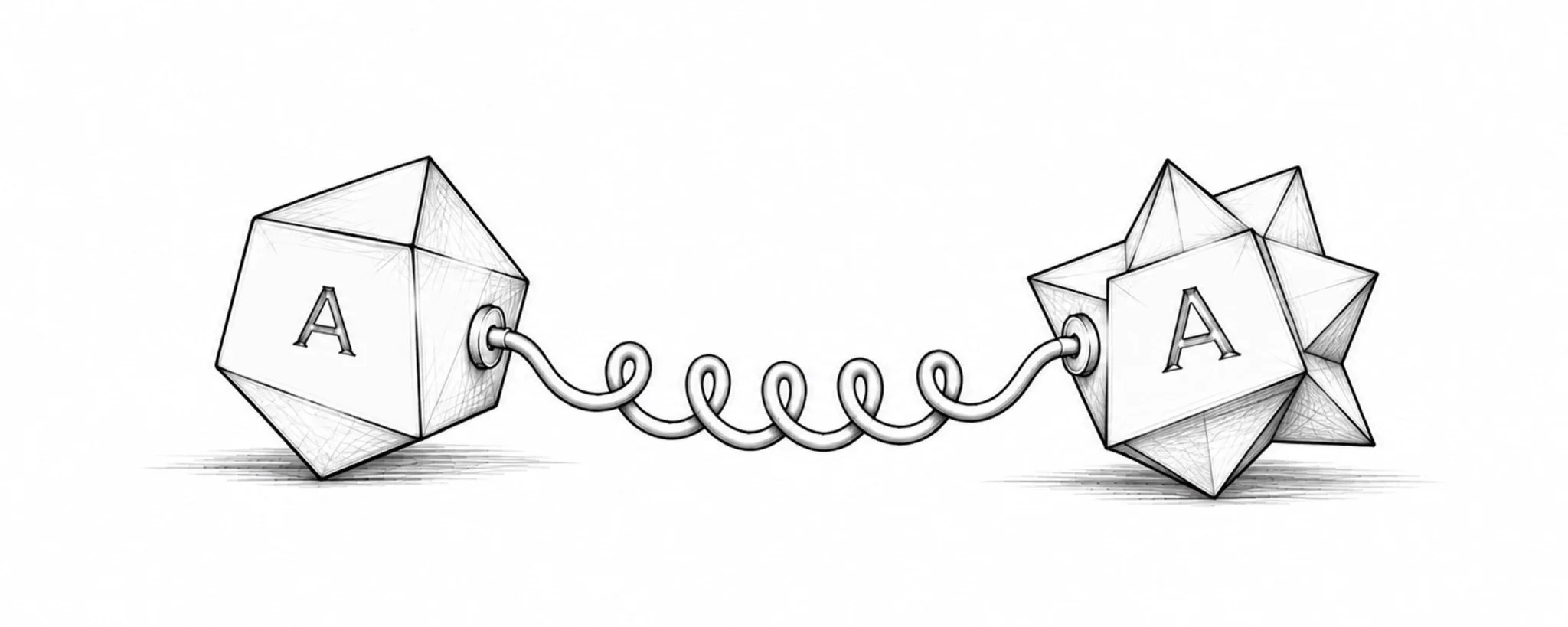
If agents work with other agents, they need a standard way to talk. That was the case for an explicit agent-to-agent protocol. Adoption is real. Meanwhile the rest of the stack has reduced how often agents need to appear to one another as independently addressable peers.

A remote agent can look like a capability. Inference stays behind the interface. Subagents live inside one runtime and die with the task. A supervisor presents one identity while specialists stay internal. Software factories coordinate the work, not a mesh of persistent agent relationships. Workflow engines treat agents as steps in a graph they already own. Handoffs can be artifacts in durable state rather than messages. Queues and event buses already do this at scale.

Aug 27, 2026Β·x.com

When You Become the Infrastructure

Give agents computers, memory, tools, and enough autonomy to keep working after you leave, and a hidden job appears. The human becomes the infrastructure: routing work, restoring context, reconnecting stale sessions, and carrying findings between specialists.

Making each agent smarter does not remove that load. Two agents can both claim the same task and both answer well, producing one failed collaboration. An ordinary request to put a workspace on GitHub can quietly include credentials. The agent that created a project’s canonical repository can later forget that the repository exists. A bot can send 34 true alerts about the same stalled job and destroy the channel as a signal.

Aug 9, 2026Β·arxiv.org

An Agent Is Just a Python Object - Introducing Object Oriented Agents

Most agent frameworks split the system across prompt templates, tool schemas, callback code, and workflow graphs. The result is fragile and hard to reason about.

A simpler model is possible. Treat the agent as an ordinary Python object. Its methods are the actions the model can take. Its fields hold state. Its docstrings serve as prompts. Its type annotations act as contracts. Methods whose body is an ellipsis are completed at runtime by an LLM-driven loop. Methods with normal bodies remain ordinary deterministic Python.

Jun 9, 2026Β·arxiv.org

Agentopia: When Agents Learn to Live

Most current AI agent research focuses on short-term tasks or narrow goals. Agentopia takes a different approach: it simulates entire lives.

The framework places 100 LLM-powered agents into persistent social worlds and runs their lives for 10 simulated years. Agents plan, form relationships, pursue personal growth, manage finances, experience setbacks, and make trade-offs between striving and well-being β€” all without heavy hand-engineering.

May 30, 2026Β·arxiv.org

AutoScientists: Self-Organizing Agent Teams for Scientific Discovery

A new paradigm replaces rigid central planners with decentralized, self-organizing agent teams that autonomously run long-horizon scientific experiments.

The system features shared state, peer critique, dynamic team formation, a dead-end registry, and noise-aware validation. This enables agents to self-correct, specialize roles, and collaborate effectively without constant human intervention.