
The Knowledge LedgerThe Knowledge LedgerFollow on WhatsApp

A curated stream of high-signal insights across Technology, Healthcare, Lifesciences, AI, Oncology, Business, Entrepreneurship, Leadership, Philosophy and beyond.

Thoughtful, cross-disciplinary content designed to expand how you think, not just what you know.

No noise. Only substance.

Filtered by #ai-economicsClear filter
Jul 2, 2026·x.com

Intelligence Is Becoming Abundant — What Happens Next?

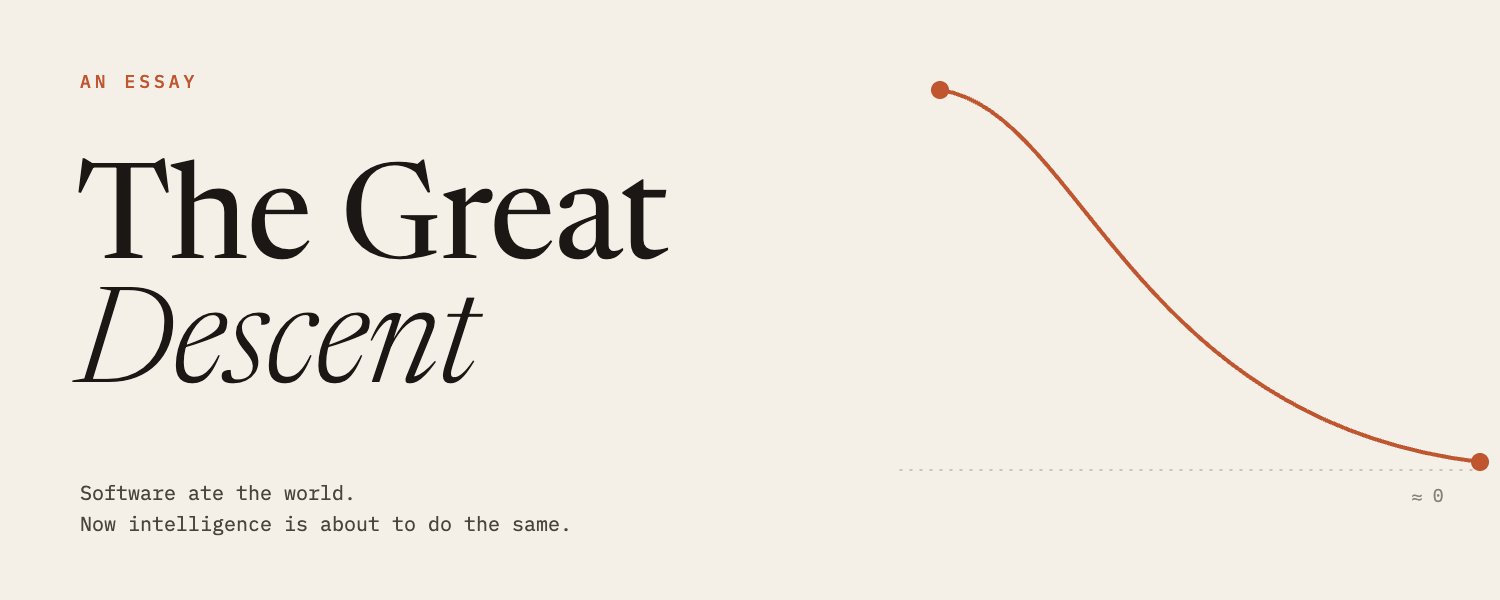
Fifteen years after Marc Andreessen declared that "software is eating the world," we are entering the next phase: intelligence itself is becoming abundant and nearly free.

Just as information became abundant through the internet, expertise and judgment — the scarce resource that was locked inside trained professionals — is now descending the cost curve at extraordinary speed. This descent is happening on two compounding curves at once: cheaper hardware and more efficient models. The result is that high-quality reasoning, once expensive and rationed, is rapidly becoming a commodity.


Jul 1, 2026·x.com

The AI Industry Is Shifting from Intelligence to Intelligence Per Dollar

The dominant conversation in AI still revolves around which company has the smartest frontier model. However, the real economic transition underway is from maximizing raw intelligence to maximizing intelligence per dollar.

Enterprises are rapidly discovering that most workloads do not require the most expensive frontier models. As inference costs continue collapsing at an extraordinary rate, organizations are shifting from asking "Does AI work?" to "Does it work economically at scale?" This change favors cheaper, "good enough" models (including open-weight ones) for the vast majority of tasks, while reserving frontier intelligence only for high-value problems where additional capability creates outsized returns.

May 22, 2026·x.com

Credit for Agents Without a Pulse

A new class of economic actor has arrived: autonomous agents that hold bank accounts, sign contracts, hire employees, and incur real financial obligations with no humans in the decision loop.

Traditional credit analysis collapses. The five classic pillars — management team, board oversight, audited statements, track record, and legal accountability — all assume human institutions. Remove the humans and the entire framework stops applying.

May 16, 2026·x.com

AI Labs Face Three Distinct Economic Problems

Frontier AI labs are not competing on the same playing field. Each has a unique identity that creates its own structural bottleneck.

OpenAI serves over 900 million monthly active users, mostly consumers. This produces a severe usage-mix problem: high volume of low-value prompts drives enormous inference costs with low revenue per token.