
Intelligence Is Becoming Abundant — What Happens Next?
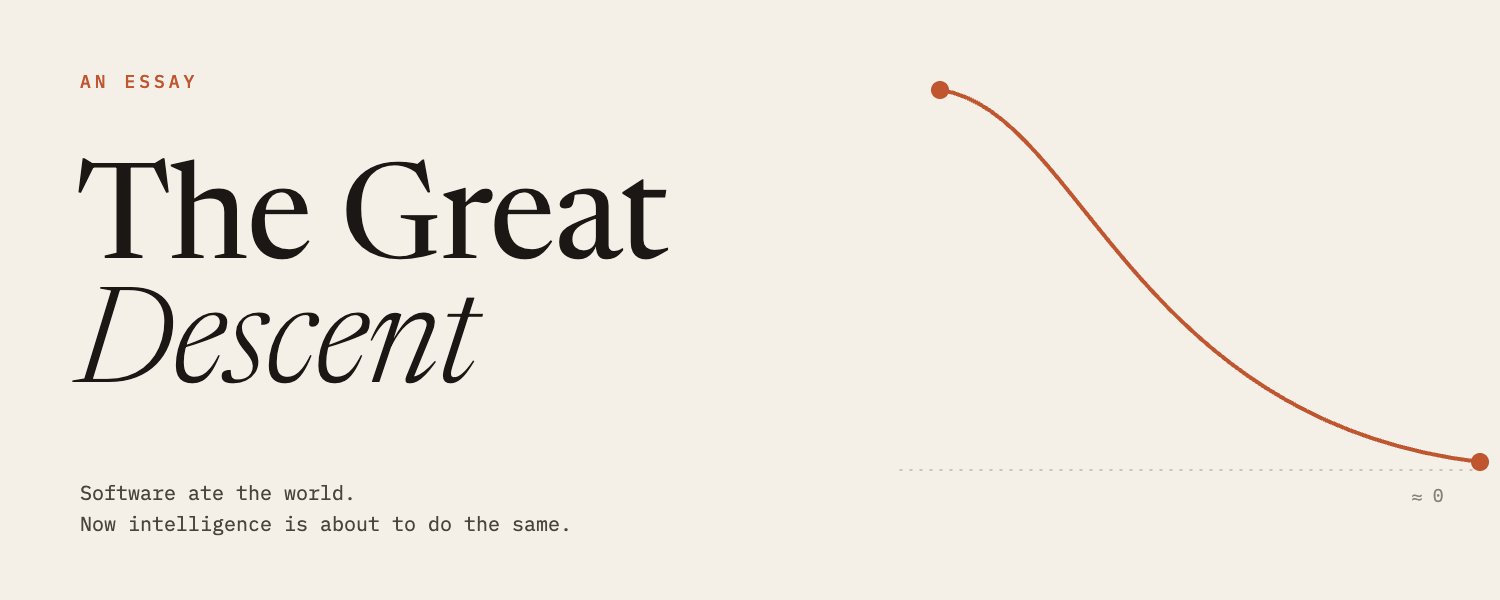
Fifteen years after Marc Andreessen declared that "software is eating the world," we are entering the next phase: intelligence itself is becoming abundant and nearly free.
Just as information became abundant through the internet, expertise and judgment — the scarce resource that was locked inside trained professionals — is now descending the cost curve at extraordinary speed. This descent is happening on two compounding curves at once: cheaper hardware and more efficient models. The result is that high-quality reasoning, once expensive and rationed, is rapidly becoming a commodity.
When something valuable becomes radically cheaper, history shows we do not use less of it. We use dramatically more, and we invent entirely new applications. Cheap intelligence will not eliminate human work — it will multiply the number of decisions that can be made and shift humans from producing analysis to deciding what the analysis is for and what to do with it.
The real competitive question is no longer "Who has access to intelligence?" but "Who is encoding their own proprietary edge into systems that compound over time?" Companies that simply rent generic intelligence and apply it to generic workflows will become interchangeable. The winners will be those who take their hard-won tacit knowledge, processes, and judgment and build them into living, scalable systems before everyone else does.
This Ledger Entry expands how readers think about the economics and strategy of AI by showing that as machine intelligence becomes radically cheaper and more abundant (on two compounding cost curves), the competitive advantage shifts from accessing intelligence to encoding your own proprietary edge, processes, and judgment into scalable systems before it becomes commoditized.