
The Knowledge LedgerThe Knowledge LedgerFollow on WhatsApp

A curated stream of high-signal insights across Technology, Healthcare, Lifesciences, AI, Oncology, Business, Entrepreneurship, Leadership, Philosophy and beyond.

Thoughtful, cross-disciplinary content designed to expand how you think, not just what you know.

No noise. Only substance.

Filtered by #medical-aiClear filter
Aug 8, 2026ยทbiorxiv.org

StainX: Making Stain Normalization Scale

Color variation across histopathology slides remains one of the most stubborn sources of noise in computational pathology. Different scanners, staining protocols, and laboratories produce images that look systematically different even when the underlying tissue is similar. This batch effect degrades the performance of AI models, especially foundation models trained across multiple institutions.

Classical stain normalization methods (Histogram Matching, Macenko, Reinhard) are training-free, interpretable, and effective. The problem is speed. Existing implementations process images sequentially or fail to fully exploit modern GPUs, making them impractical for the tens of thousands of tiles that make up large whole-slide image cohorts.
Aug 2, 2026ยทarxiv.org

RadHarmony: Making Radiological Data Work for Agentic AI

Training models on radiological images is still slowed by a basic infrastructure problem. Public datasets differ in file formats, directory structures, label schemas, and annotation types. Integrating them into a single training pipeline usually requires custom, one-off engineering for each source.

RadHarmony is an open-source library designed to remove that friction. It standardizes metadata from 24 public datasets into a unified format and delivers samples through a single interface that supports classification labels, segmentation masks, bounding boxes, and radiology reports. The system is built to work with chest radiographs first, with early support for CT and MRI.

Jun 26, 2026ยทnature.com

Disparate Privacy Risks from Medical AI

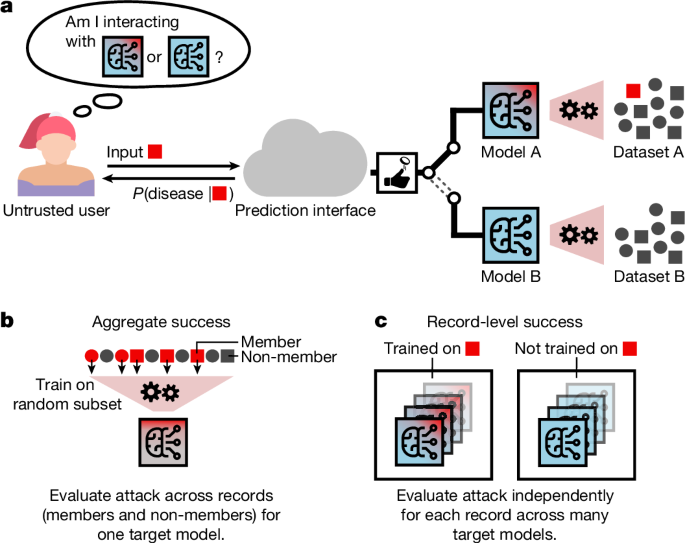
Medical AI models can leak sensitive patient information through privacy attacks, even when average risk metrics look acceptable. This paper shows that while aggregate membership inference attack success often appears close to random guessing, individual patient-level risks can be extremely highโ€” with some patients facing near-perfect identifiability.

The risks are also disparate: they disproportionately affect underrepresented groups (by race, disease prevalence, or insurance status). Larger models tend to increase these individual and group-level privacy vulnerabilities.