
The Knowledge LedgerThe Knowledge LedgerFollow on WhatsApp

A curated stream of high-signal insights across Technology, Healthcare, Lifesciences, AI, Oncology, Business, Entrepreneurship, Leadership, Philosophy and beyond.

Thoughtful, cross-disciplinary content designed to expand how you think, not just what you know.

No noise. Only substance.

Filtered by #foundation-modelsClear filter
Jul 11, 2026ยทresearch.google

SensorFM: A Foundation Model for Wearable Health Data

Wearable devices generate enormous amounts of multimodal sensor data (heart rate, motion, skin conductance, temperature, etc.), but most AI models for health are narrow, task-specific, and require large amounts of labeled data. This limits scalability and generalization in real-world settings where data is often fragmented or incomplete.

Google researchers introduce SensorFM, a large sensor foundation model pre-trained self-supervised on over one trillion minutes of wearable data from more than five million consented participants across diverse devices and geographies. It learns a general-purpose representation of human physiology using a missingness-aware framework (AIM) that treats real-world data gaps as meaningful signals rather than noise.
Jul 10, 2026ยทnature.com

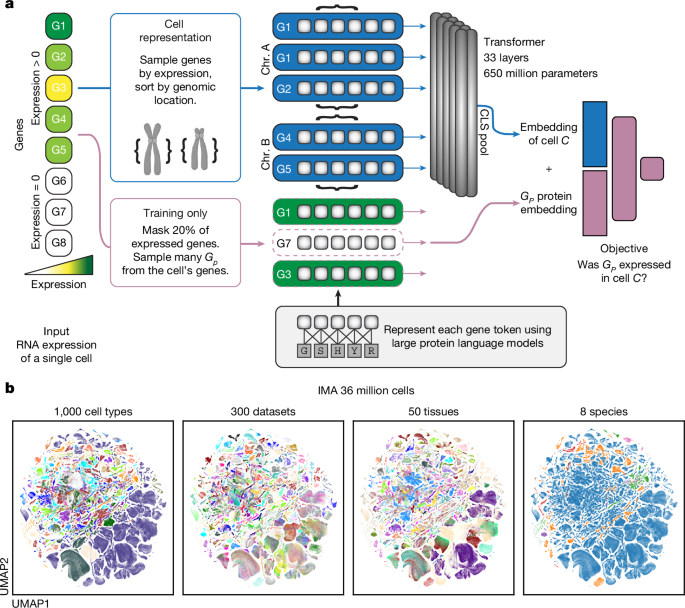
Universal Cell Embedding: A Foundation Model for Cell Biology

Single-cell RNA sequencing has generated massive datasets across tissues, experiments, and species, but integrating and analyzing them remains challenging due to batch effects, species differences, and the need for extensive annotations.

Researchers introduce UCE (Universal Cell Embedding), a foundation model trained self-supervised on 36 million cells. By representing cells as "bags of RNA" ordered by genomic location and leveraging protein language models (ESM2), UCE learns a unified latent space that captures biological variation while remaining robust to experimental noise.