
The Knowledge LedgerThe Knowledge LedgerFollow on WhatsApp

A curated stream of high-signal insights across Technology, Healthcare, Lifesciences, AI, Oncology, Business, Entrepreneurship, Leadership, Philosophy and beyond.

Thoughtful, cross-disciplinary content designed to expand how you think, not just what you know.

No noise. Only substance.

Filtered by #ai-in-healthcareClear filter
Aug 27, 2026ยทresearch.google

A Foundation Model for Glucose Time

Continuous glucose traces look like one noisy curve. They are not. They contain a slow baseline and short-term deviations from meals, activity, and sensor artifacts. GlucoFM is built around that split.

The model is a lightweight, self-supervised foundation model for continuous glucose monitoring. One stream tracks slower metabolic state. The other tracks transient events. Time of day is preserved. Missing readings are masked rather than invented. Pretraining predicts latent structure instead of reconstructing raw noise, and uses augmentations that mimic real device failures: drift, sparse sampling, brief disconnects.
Jun 30, 2026ยทnature.com

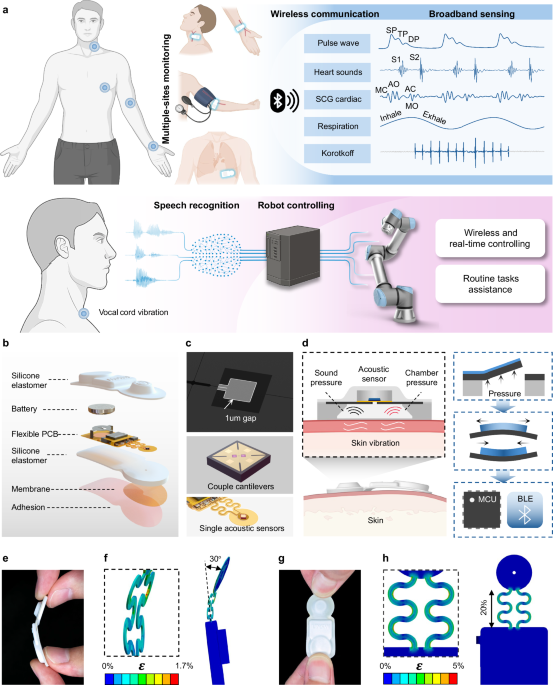
One Patch That Hears Your Whole Body

Traditional stethoscopes and commercial MEMS acoustic sensors have limited frequency range, making it hard to capture the full spectrum of physiological signals (from very low-frequency respiration and pulse waves to high-frequency heart sounds and vocalizations) in a single wearable device.

Researchers have developed AusculPatch โ€” a lightweight, flexible, wireless auscultation patch that uses a novel cantilever pressure transducer with a nanothin cantilever and tiny airgap. This design enables broadband sensing from 0.2 Hz to over 10 kHz in one compact, low-power device (~3.2 g, 4.5 mW).

May 18, 2026ยทnature.com

Reti-Pioneer: One Retinal Scan Detects Multiple Systemic Diseases

A new AI framework turns routine retinal imaging into a powerful noninvasive window for simultaneous detection of multiple metabolic and endocrine disorders.

The system combines quality-aware modules with frozen foundation models to deliver accurate, interpretable predictions from standard eye scans in under 30 seconds.